Gartner predicted that through 2026, organisations would abandon 60% of AI projects not backed by AI-ready data.
2026 is almost over.
Most of those projects didn't fail on the model. They failed on the data underneath.
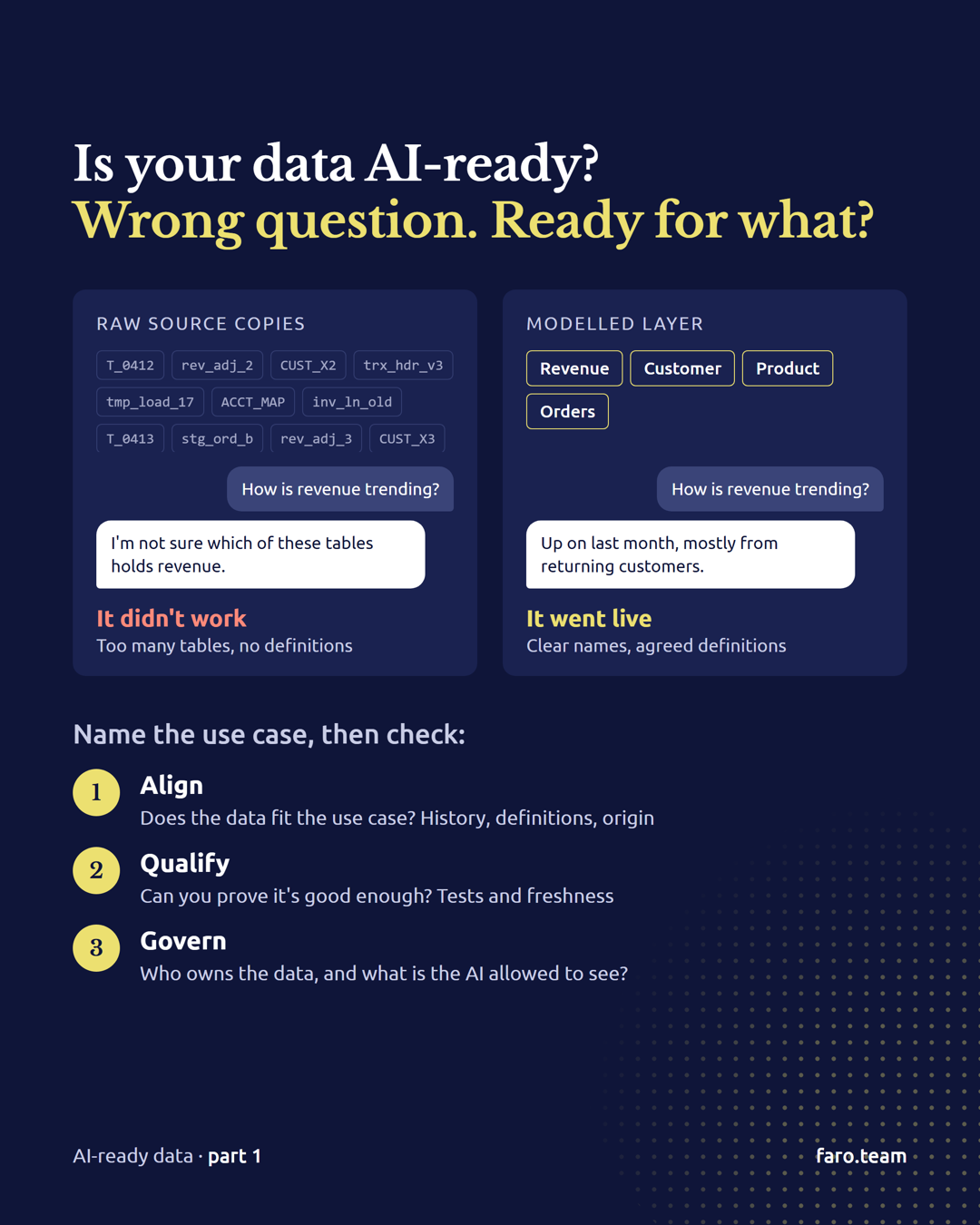
We saw this up close. One of our clients wanted a chatbot on top of the raw data: one-to-one copies of the source systems, cryptic column names, no business definitions. We built a proof of concept on exactly that.
It didn't work. There was far too much source data, and the agent couldn't work out which tables it needed to answer a question. It simply didn't know which data to use.
The assistant went live only after we put a modelled layer underneath it, with clear names and agreed definitions.
So, is your data AI-ready? Wrong question.
Gartner puts it plainly: there is no way to make data AI-ready in general or in advance. The data behind a solid sales forecast can be useless for an HR assistant. Same company, same warehouse, different answer.
The better question is: ready for what? Once you name the use case, you can check it in three steps:
Over the next weeks we'll go through these areas one by one: data models, catalog and lineage, quality and freshness, security.
Has Gartner's prediction come true where you work? Tell me in the comments, or send me a message if you'd rather talk about your own use case.
Sources:
Join the conversation:
Seen this in your company? Share your take under Mariusz's post on LinkedIn →